Among the products Rhode released for summer this year were a beach towel, a matching terry bag and a run of silicone phone cases in shades called colada and bronze. A phone case is not a beauty product by any ordinary measure, which is exactly what makes its place in the drop worth pausing on. It sold to the same people, in the same launch, under the same logo as the Highlight Milk and the long-teased Pocket Bronze, and it sold out alongside them. The clearest way to understand the most-watched brand in beauty right now is to stop thinking of it as a beauty brand at all, because Rhode has spent the last few years quietly building something larger and more durable than a skincare line, and this summer it showed its hand.
What Rhode's Summer 2026 Tells Us · Read Part Two

Strategy & Analysis
Hailey Bieber's Billion-Dollar Problem: Can a Brand Built on Hype Become a Legacy?
By The Desiree Team
The brand's president and chief brand officer, Lauren Ratner, has a name for the thing she is actually building, and she uses it internally rather than in any campaign. She calls it surround sound, a 360 world that starts with a highly visual creative campaign and then extends into gifting experiences and small, shareable pieces of content, all of it arranged so that a customer can step inside and stay there for a while. The towel and the phone case are not afterthoughts or merchandising filler. They are the proof of the idea, small objects that let someone carry the world out of the campaign and into their own day, and they function less like products you buy than like tokens of belonging to something. Rhode is compounding a world, and the skincare has become one expression of it among many.
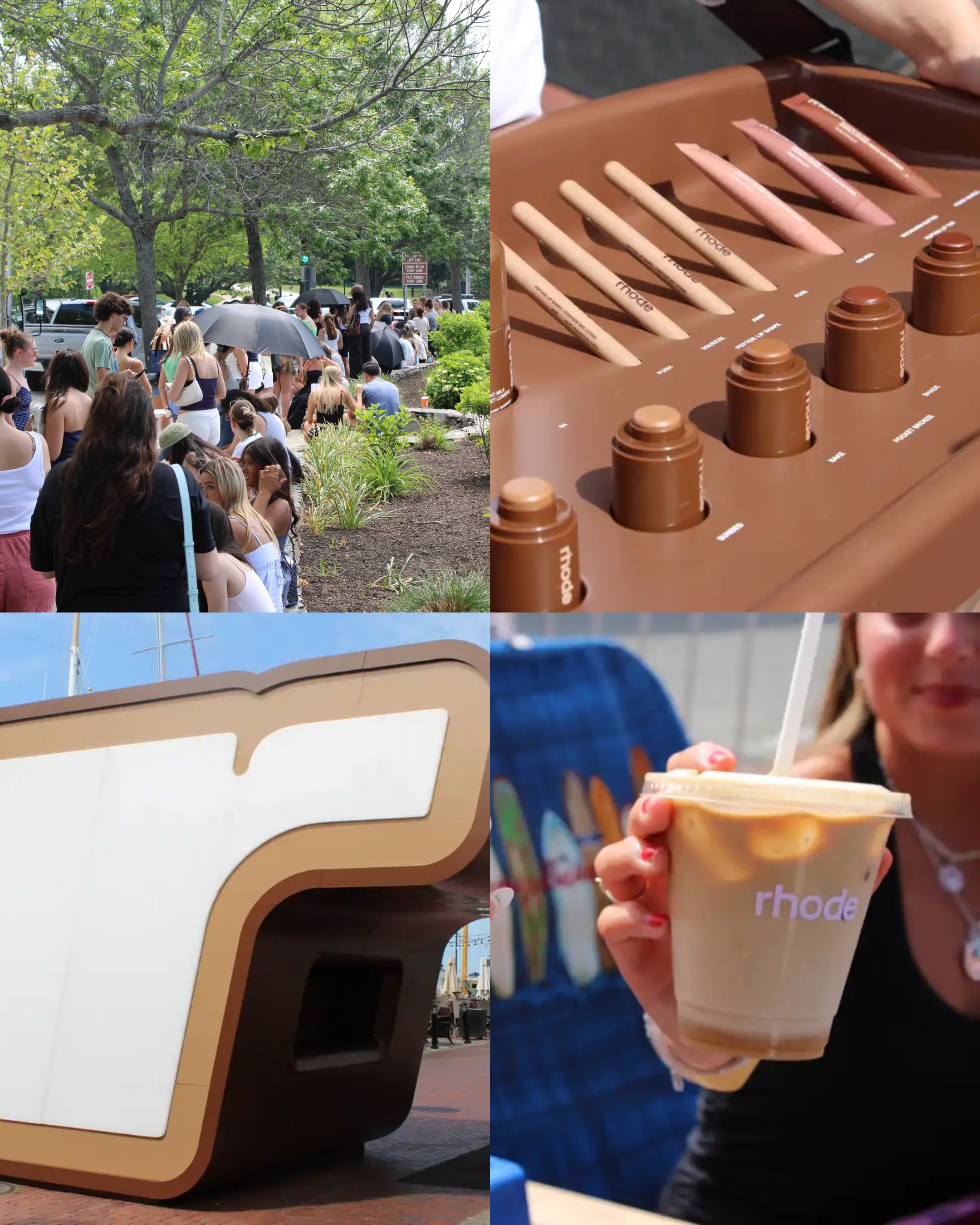
Holding that world together is a discipline almost no beauty brand attempts, and it is colour. Everything Rhode makes lives inside a single narrow band of brown, from the cocoa and bronze of the packaging to the kiosks the brand builds for its events to the colada wash across the summer accessories, and that chromatic restraint is doing serious strategic work in a category that usually competes on the sheer range of its swatches. The monochrome is what allows a fifty-dollar towel and a twenty-pound lip tint to register instantly as the same brand, and it is what gives Rhode licence to wander into categories where it has no obvious business and still look entirely coherent. Aesthetic consistency at this level becomes a kind of moat. It makes the world legible at a glance, endlessly photographable, and very difficult to imitate without simply looking like a copy of Rhode, which is the highest compliment a visual system can be paid.
The summer station is that world made physical and portable. After an off-grounds debut at Coachella, complete with a claw machine and balloon darts, Rhode is taking its travelling pop-up across the United States, Canada and Europe through the season, and the format follows a seasonal pattern the brand has now run for years. There was the photo booth in Ibiza, the Lemontini beach club takeover in Majorca, the bakery pop-up at Mecca during the Australian summer, each one arriving as its own self-contained universe with its own theme and its own colour story. The consistency of that ritual is the entire point. Rhode has trained an audience to expect a fresh world every season and to treat its arrival as an event worth travelling for, which is a remarkable habit to have built in a brand that is only four years old. When the first summer station opened in Newport this June, people brought folding chairs and waited more than twelve hours to get inside, fanned with water and handed free iced coffee while they queued, and what they were queuing for was twenty minutes inside Rhodeworld rather than any single tube of gloss.
This is why Ratner has been consistent in saying that it was never just about selling a product and that the brand has never followed the traditional playbook of simply placing an item in a store. The retail numbers are extraordinary on their own terms, with Sephora's North American launch reportedly selling three Rhode products a second over its opening weekend, and openings at both Sephora and Mecca ranking as the biggest those retailers had ever seen. Yet the leadership keeps describing the work in the language of community and storytelling and physical experience, because the products move precisely because they arrive attached to a world people already feel they belong to. The transaction is downstream of the belonging, and the belonging is the thing Rhode has been building all along.
For anyone watching how consumer brands are made now, this is the lesson worth taking from Rhode's summer, and it is bigger than beauty. The most valuable asset a modern brand can own is a world distinctive enough that its customers want to live inside it, because once that world exists it can carry almost anything, from a luminiser to a beach towel to a phone case, and each new object deepens the world rather than diluting it. Rhode understood early that a category is a limit and a world is a licence, and it built accordingly, with a colour system strict enough to hold and a seasonal ritual reliable enough to anticipate. The towel was never about drying off after a swim. It was about giving people one more way to belong, and the willingness to wait twelve hours in the heat for it tells you that the strategy is working exactly as designed.
What Rhode's Summer 2026 Tells Us · Read Part Two
Strategy & Analysis
Hailey Bieber's Billion-Dollar Problem: Can a Brand Built on Hype Become a Legacy?
By The Desiree Team


.svg)


.svg)
.svg)